

If you’ve owned a home long
enough—especially in the U.S. where weather seems to be rolling a dice every
few months—you’ve probably wondered at some point what actually happens if a
flood wrecks your place. Not the everyday “pipe leak under the sink,” but real
floodwater creeping into your home. People imagine this stuff differently until
it actually hits them, and then they realize homeowners insurance doesn’t care
about flood damage at all. That’s usually the moment people go searching for
answers like what does flood insurance cover and why they didn’t hear
this sooner.
So, let’s talk about it in a way
that doesn’t feel like reading a government pamphlet. Flood insurance is…
complicated, yes, but not impossible to understand once you strip away the
fancy labels. The whole point of 2025’s conversation around flood insurance
coverage is that things have changed—weather patterns, flood zones,
rainfall intensity… even places that never used to deal with floods are
suddenly showing up on insurance claim charts.
The
Weird Reality About Flooding Now
A cousin of mine in New Jersey (who
never even considered flood insurance) had water enter her basement for the
first time in twenty years. Not after a hurricane, not near a river—just a
freak storm where the drainage system gave up. She said the worst part wasn’t
even the damage… it was realizing how unprepared she was. And she’s not alone.
You’d think floods only hit Florida,
Louisiana, the Carolinas—basically the usual suspects. But now? Vermont had
towns underwater, California saw floods after heavy rains, and even Nevada had
a couple of bizarre flooding episodes. No one wants to admit it, but the map of
“safe zones” is shrinking.
FEMA has this number that’s honestly
hard to believe the first time you hear it: one inch of water can cause more
than $25,000 in damage. One inch. That’s basically a spilled bottle of Coke
but multiplied by the entire square footage of your house.
Anyway — let’s move past the
doom-circle and actually explain what you get when you buy flood insurance.
What
Flood Insurance Actually Covers (The Helpful Part)
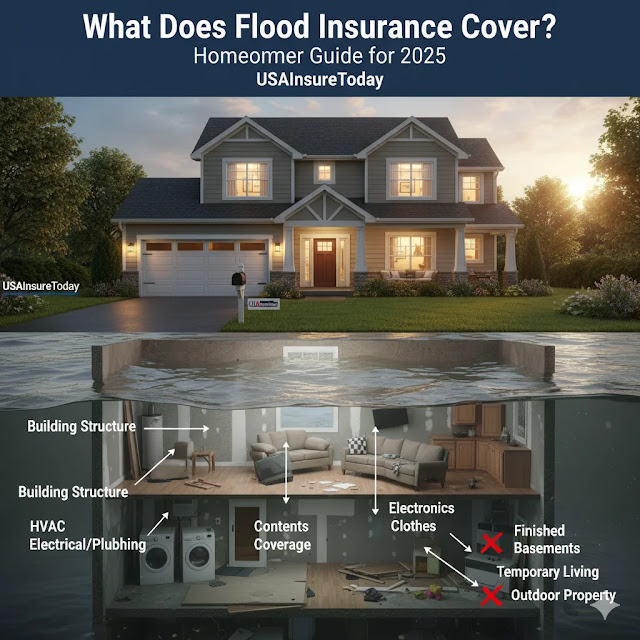
Here’s your flood insurance coverage explained in the simplest way possible.
There are two big buckets. And
they’re pretty simple:
- Your home’s structure (building coverage)
- Your belongings (contents coverage)
Some people only choose one, which I
personally wouldn’t recommend unless you enjoy surprises.
1.
Building Coverage — the house itself
This is the part that pays for the
things permanently attached to your home. Think of it like the bones and the
vital organs.
It typically covers:
- The foundation
- Electrical and plumbing systems
- The HVAC system (AC, heating, ductwork—all the
expensive stuff you don’t want to replace alone) - Built-in appliances
- Walls, floors, insulation
- Cabinets that are permanently installed
- Water heaters
- Debris removal
You’d be surprised how many people
forget that just cleaning up after a flood costs thousands. Mud, trash, soaked
insulation—it all needs to go.
If the water touches something
that’s part of your home’s permanent structure, building coverage is usually
where it falls.
2.
Contents Coverage — the everyday “stuff”
This part matters a LOT more than
people think.
If floodwater gets inside your home,
it doesn’t politely avoid your belongings. It hits everything at ground level
first—couches, electronics, kids’ toys, shoes, books, clothes, all of it.
Contents coverage typically
includes:
- Furniture
- Electronics
- Clothes
- Small appliances
- Area rugs
- Certain valuables (with limits, of course)
- Washer/dryer
- Decorations, shelves, lamps, etc.
It’s the part that helps you rebuild
your home as a livable home, not just four walls and a roof.
The
Stuff Flood Insurance Won’t Cover (People Hate This Part)
Now, let’s be honest: insurance
companies—especially government-backed ones—are not generous. Flood insurance
has some gaps that annoy homeowners.
Here are some that catch people off
guard:
✘ Finished basements
✘ Temporary housing / hotel stays
✘ Outdoor things
✘ Cars
✘ Anything damaged because you waited too long
Knowing this list helps you plan
better. Some private insurers offer better options for these uncovered
items—more on that in a second.
NFIP
vs. Private Flood Insurance (The Not-So-Boring Comparison)
Most people only hear about NFIP,
which is the federal flood insurance program. And honestly, for a lot of
households, it works fine.
NFIP gives you:
- $250k max for the structure
- $100k for contents
- Standardized rules
- Government backing
- Slow but reliable process
- A 30-day waiting period
This is the go-to option for homes
in high-risk areas.
Private flood insurance, on the other hand, is like the more flexible cousin:
- Higher coverage limits (some go up to $1M+)
- Coverage for temporary housing
- Optional basement coverage
- Shorter waiting periods
- Better coverage for valuables
People with newer homes or more
expensive belongings often lean toward private policies simply because NFIP
limits feel outdated.
Flood
Policy Basics Without Making It Complicated
Let’s keep this simple:
What
counts as a flood?
Insurance defines it as water
covering at least two acres or two properties.
Flood
zones matter — but not the way you think
- Zone A and Zone V = high risk
- Zone X = “lower” risk
But lower risk does NOT mean no
risk. Most recent flood claims actually came from “non-flood zones,” which is
ironic.
What
Flood Insurance Costs in 2025
Typical ranges:
- NFIP: $700–$1,500 per year
- Private: $600–$2,500
Factors include:
- Elevation
- Distance to water
- Home age
- Foundation type
- Zone
- Claims history
- Coverage choices
Choosing
the Right Flood Policy: A Few Practical Thoughts
✔ Don’t skip contents coverage
✔ Compare NFIP and private policies
✔ Photograph your home yearly
✔ Don’t wait until a storm warning
✔ Review your flood zone every year
A
Realistic Closing Thought
Flooding isn’t something people like
to think about until the water is already at the doorstep. And by then, the
only thing you can do is move fast and hope your insurance paperwork is in
order.
Knowing what flood insurance covers
gives you a real sense of control in a world where the weather doesn’t always
make sense anymore. And honestly? If there’s one thing 2025 has taught
homeowners, it’s that “unlikely” doesn’t mean “impossible.”
Whether you’re in a so-called safe
zone or not, getting your flood insurance coverage explained clearly and
choosing a plan that matches your home is one of the smartest moves you can
make to protect your home from floods and the financial mess they leave behind.
